-
Formulate questions on a specific science topic and choose the steps needed
to answer the questions.
-
Use data to produce reasonable explanations.
-
Collect data for investigations using scientific process skills including
observing, estimating and measuring.
-
Describe simple life cycles of plants and animals and the similarities
and differences in their offspring.
-
Describe relationships among various organisms in their environments.
-
Explain why keeping accurate and detailed records is important.
-
Write paragraphs that include a variety of sentence types with accurate
spelling, capitalization and punctuation.
-
Read, comprehend, interpret, evaluate and use written material.
-
Visit a forest preserve, nature center or state park and
ask the park ranger or manager to meet with the students. Ask the ranger
to discuss his/her job, and what the special satisfactions in the job are.
You might also ask the ranger to lead the students through a walk in the
woods.
-
Make a bulletin board about “Woodland Creatures,” “Changing
Seasons in the Woods,” or “Animal Tracks Found in the Woods.”
-
Collect various leaves and bark samples and talk about
their differences. Have the students feel the different barks and compare
and describe each one.
-
Make a Nature Discovery Corner in your classroom. Have
the students bring in “their discoveries” and write a short
description of what they found.
-
Make plaster casts of tracks you have seen in the woods.
They can be found on trails, near feeding sites, and water sources. Students
can identify what the animal is. Then have them research on the animal,
where it lives, what it eats, its size, and how many offspring it has.
The students
can explore what the animal's relationship is to other living things in
the woods.
-
Woods-Walker Diaries – Ask the students to keep
a journal of a wooded area that is close to the school or home. Have them
visit the area regularly to note changes.
They
might include drawings or photographs of what they see.
-
Create a woods glossary. Ask each student to define a “woods
word” and decorate the classroom with the terms.
-
Create a woods ecosystem by placing soil in the bottom
of an aquarium. Then place a layer of dead leaves on top of the soil. Place
a dead, rotten log on top of the leaves. Watch what happens. Does anything
begin to grow out of the soil or emerge from the long?
-
During a walk in the woods, ask the students to find as many different
tree seeds as they can. The best time to do this is in the spring
or fall. Why do some trees drop their seeds in the spring and some in
the fall? It is a dormancy issue. Those that drop in the spring do not
require
cold to germinate. Those that drop their seeds later in the summer or
fall require a cold dormancy period in order for them to germinate. Some
seeds to look for are acorns, walnuts, hickory nuts, and some maple seeds,
and pine cones.
Set up an experiment with several different tree seeds. You will be determining
which seeds need a cold treatment to germinate. You will need two seeds
of each tree. Plant each seed in a different pot. Place half the pots in
the windowsill and the other half in a refrigerator for 1-3 months. Then
take the pots out of the refrigerator and water well. Compare with the
ones that are on the windowsill. This process is called stratification
where seeds are subjected to a specified amount of cold to overcome seed
dormancy.
-
In the spring, take the students for a walk in the woods
and mark off a 3 feet by 3 feet area with string. Go back and visit the
area periodically to observe the changes in the area and what you see growing.
You could select two or three different places, each having a different
habitat such as a dead log, leaf litter, bare ground, area in the sun,
an area in the shade, or a spot along a stream.
-
Discover ways living creatures camouflage themselves in
the woods. Discuss color, patterns, and shapes that you find in the woods
and how they can protect creatures from harm. For instance, a walking stick
(an insect) on a branch is hardly noticeable. A frog along a stream edge
is hard to see. What others can you come up with? It’s like an I
SPY game. What do you think living creatures do in the winter to protect
themselves?
-
Talk about how the seeds can move from place to place.
Some stick to our clothing or animals' fur, some fly like helicopter blades,
and others
spread
through
bird and animal droppings. Have the students find and record as many seeds
as they can in their journal.
-
Litter spoils the woods and can hurt the animals and visitors.
As a special project, have the students pick up litter in the woods and
then dispose of it properly. Weigh how much litter was collected and make
a list of the things that were found. Contact the media to do a story on
the children's concern for their environment.
-
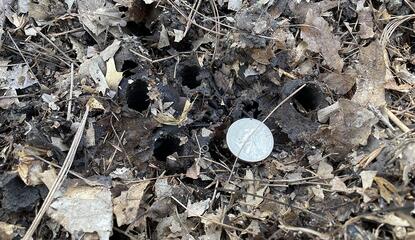
On a walk in the woods spot some animal and bird homes.
Look for nests, burrows in the ground, hiding places in trees, or drilled
holes in a tree which usually means a woodpecker is nearby.
-
Have a scavenger hunt checklist for a walk in the woods.
The students can look for seeds and acorns, various kinds of leaves, bones
from dead
animals
or birds, gnawed or rubbed off bark, animal paths, nests or flattened grass
where an animal might have been laying.
-
Look for animal tracks. Look for tracks by muddy
paths and puddles, near water or streams, and in the snow. See if the students
can identify them.
-
Look for different shapes and colors of mushrooms. Don't
touch them – rather have the students draw a picture in their journals.